At the end of June, the IAEA published the first public map of the world’s spent nuclear fuel. It is a good moment to look at what that fuel actually is, because most of what we call nuclear waste is not waste at all. It is fuel we have not learned to use yet
Thomas Jam Pedersen — July 16th, 2026
A map worth having
At the end of June 2026, the IAEA released the first public tool mapping how much spent nuclear fuel the world has produced and where it now sits. I have wanted a single, comparable picture like this for years. Until now, we had estimates that never quite agreed with each other.
The headline numbers are worth stating plainly. About 448,000 tonnes of heavy metal have been discharged from power reactors since the industry began. Roughly 322,000 tonnes are sitting in storage, and about 126,000 tonnes have already been reprocessed. I take this as a data point, the way I take every development in this industry as a data point, and it tells me something the industry rarely says out loud.
It is smaller than you think
Nuclear power has generated electricity for more than 70 years. The first reactor put power onto a grid in 1954. In that time the world’s reactors have produced somewhere around 110,000 TWh of electricity, close to a tenth of all the electricity humanity has used, decade after decade. And the total spent fuel from all of that is 448,000 tonnes. Stacked together, it would fit inside a cube well under 40 metres on a side.
That is the entire high level legacy of 70 years of the densest energy source we have ever built. I want to be precise here, because it is easy to compare apples with oranges. This figure is spent fuel only. It does not include low and intermediate level waste, this material is concentrated in one place, rather than spread through the air we breathe. But the point holds. By mass and by volume, this is a remarkably small problem for the amount of energy it represents.
It is not waste
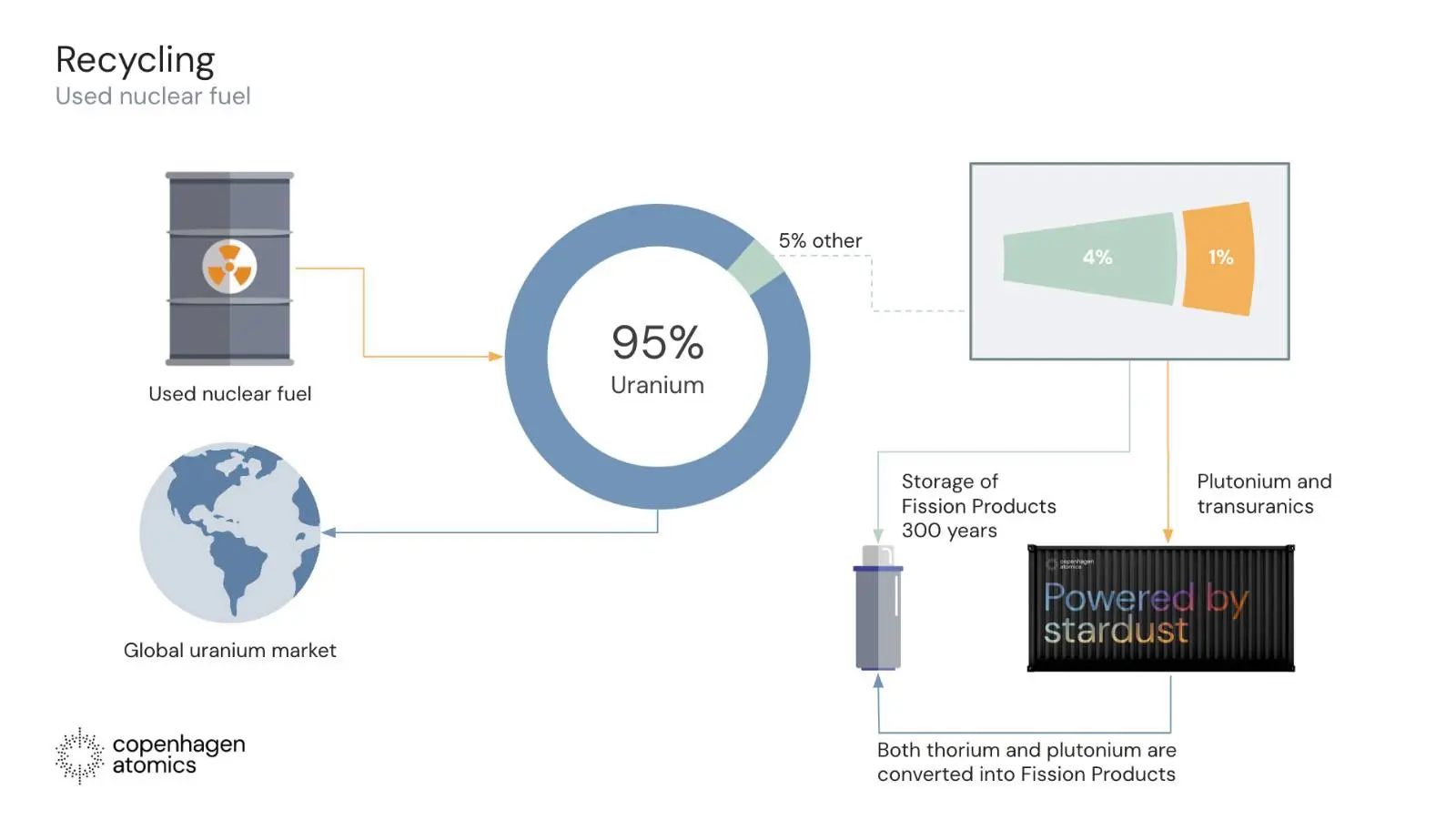
Here is the part almost nobody outside the industry understands. Spent nuclear fuel is mostly fuel. When fuel comes out of a normal light water reactor, it is roughly 95% uranium, about 1% plutonium and other transuranics, and about 4% fission products. The uranium and the transuranics are fuel. Only the 4% of fission products are genuinely spent.
So why do we throw away 96% of it? Because of the form. Solid fuel rods can only be burned so far before fission products build up, poison the chain reaction, and force the reactor to eject the rod. A light water reactor burns only about 5% of the fuel it loads, and across the whole cycle it extracts less than 1% of the energy that was in the uranium we originally dug out of the ground. We mine uranium, enrich it, use a sliver of it, and bury the rest while calling it waste.
It is a separation problem, not an energy problem
The energy is still in there. The barrier is chemistry and economics. To reuse spent fuel, you have to separate it, and separation is expensive. Reprocessing costs somewhere between 1,000 and 2,000 dollars per kilogram of heavy metal. As long as fresh uranium is cheap, it is simply cheaper to mine and enrich new fuel than to recover the old. That is the entire reason recycling never became standard. It is not that it cannot be done. It is that in a world of cheap uranium and once-through reactors, nobody bothered.
Some countries do reprocess. France reprocesses most of its fuel at La Hague, Russia at Mayak, and Japan, India and China all run or are building plants. Historically, the UK reprocessed more than almost any other country. But look closely at what they do with it. They recover uranium and plutonium, turn the plutonium into MOX fuel, and burn it once more in ordinary reactors. It reduces the volume a little. It does not close the fuel cycle, and it does not deal with the transuranics that make the waste radioactive for a hundred thousand years.
What every country now has to deal with
This is where the IAEA map earns its keep. For the first time, you can see, country by country, how much spent fuel each nation is now responsible for. And every one of them treats it as a liability. The strategies are the same everywhere. Keep it in cooling ponds, move it to dry casks, and eventually bury it deep underground. Finland is about to open the world’s first geological repository. Everyone else is paying to store a problem, and planning to pay far more to bury it for longer than human civilization has existed.
Separate it, and the problem shrinks to 4%
Now change the frame. Imagine you separate that spent fuel instead of burying it. When you separate light water fuel, the 95% uranium comes out still above natural, good enough to be used directly by CANDU type reactors. The 1% transuranics become excellent kickstarter fuel for CA reactors. The zirconium can be recycled, and you are left with the ~4% fission products. That is the only part you actually have to store.
It gets better. Those fission products decay away in about 300 years. It is the transuranics — the plutonium and the minor actinides — that drive the hundred thousand year timescale everyone worries about. Take them out and put them to use, and the material you are left with returns to the radioactivity of natural uranium ore in roughly three centuries, not a hundred millennia. You have turned a geological problem into an engineering one.
Not all spent fuel is equal
There is one honest complication, and it is worth being clear about. Everything above describes light water fuel, which is most of the world’s fleet. Its recovered uranium is above natural, so it has somewhere to go, even into CANDU reactors.
Heavy water reactors are the exception. The CANDU and PHWR designs used in Canada, India, Romania and Argentina, along with Korea’s Wolsong units, run on natural uranium and burn it so lightly that their own spent fuel comes out with depleted uranium, below natural. There is little to recover there. Copenhagen Atomics can still use the transuranics from this fuel, and CANDU plutonium is actually unusually good kickstarter material, but there is no uranium to reuse and only about a third as much plutonium per tonne. So separating CANDU fuel is a weaker case, and I keep it apart from the numbers below.
What this means for CA reactors
So what could actually be done with the transuranics the world is currently guarding? We took the IAEA data and built it out for every country in the dataset, including the United States, which on its own holds more than a fifth of all the spent fuel in the world.
For the light water fuel, where the recycling case is strong, there are roughly 2,500 tonnes of transuranics still locked inside stored spent fuel, plus more than 300 tonnes of plutonium that has already been separated and is sitting in stores in the UK, France, Russia and Japan. That is about 2,800 tonnes of transuranic fuel that nobody currently has a use for.
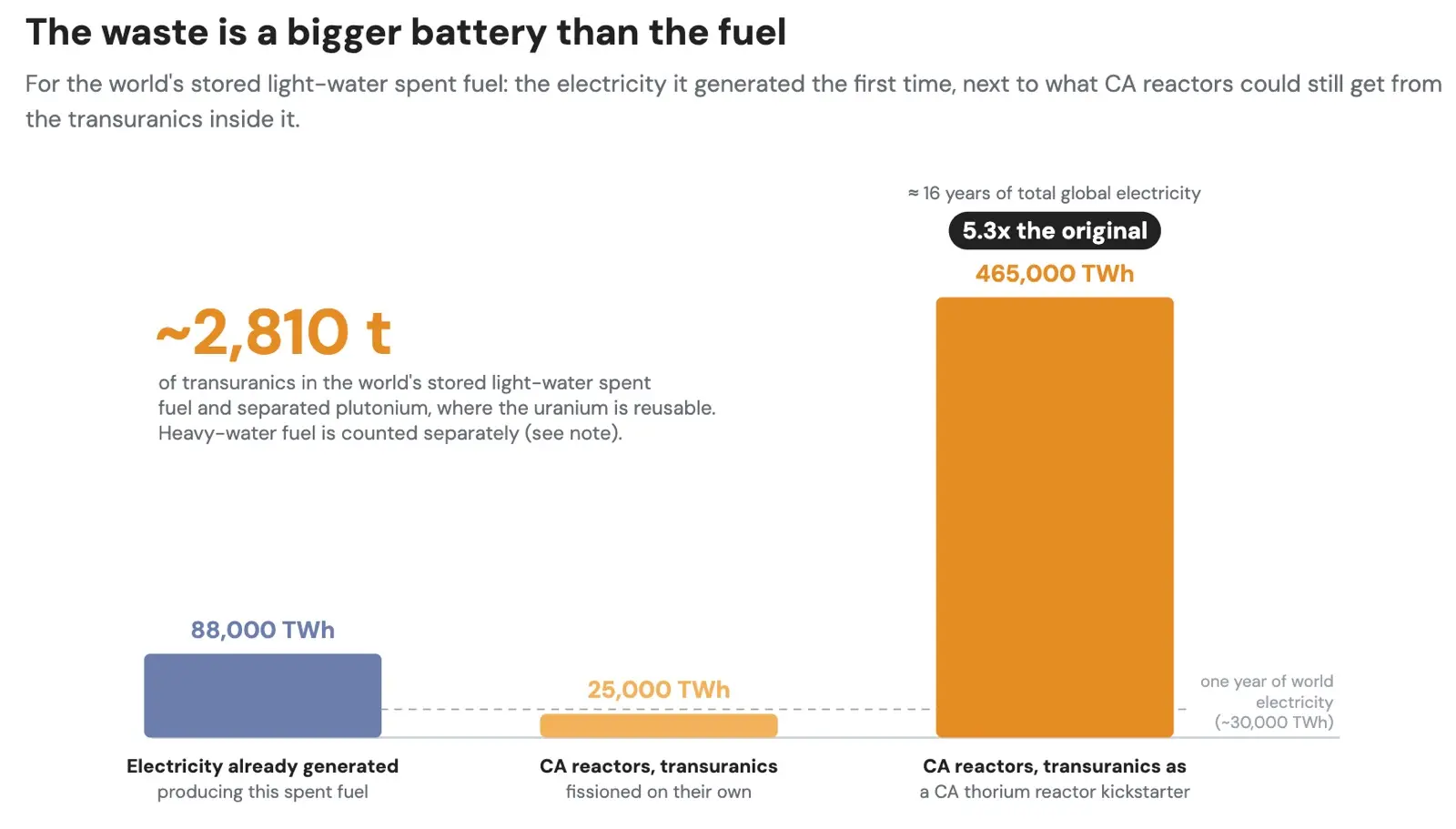
Fissioned directly, 2,800 tonnes of transuranics is about 25,000 TWh of electricity, almost one year of total global electricity production. Then this highly valuable fuel would be gone forever.
But CA reactors do not simply fission the transuranics. We use this TRU as the kickstarter fuel that ignites a thorium breeder, and the thorium then carries the reactor for a century. On that basis, the transuranics in this light water fuel could start enough CA thorium reactors to generate on the order of 465,000 TWh over the next 50 years — about sixteen times the current annual electricity production. And then the fleet of CA reactors would keep going, because they now run predominantly on thorium which we will never run out of.
Here is the part that should stop people in their tracks. That so-called waste holds more electricity than the fuel produced the first time it was used. The light water fuel now in storage generated about 88,000 TWh of electricity on its way to becoming waste. The transuranics left inside it, used as a CA thorium reactor kickstarter fuel, could generate roughly five times that. We are not looking at the ash from a fire. We are looking at a larger fire that has not been lit.
The heavy water fuel adds a further 290 tonnes of transuranics and about 48,000 TWh of potential, most of it in Canada, which holds the largest tonnage of spent fuel in the world. It is real fuel, but a lower priority, because none of its uranium is recoverable and the plutonium yield per tonne is low.
| Country | Spent fuel in storage (tHM) | Electricity already generated (TWh) | Transuranics available (t) | Electricity CA could generate (TWh) | Waste left to store |
|---|---|---|---|---|---|
| Light water fuel — uranium reusable | |||||
| United States | 94,666 | 33,739 | 947 | 156,733 | 3,787 |
| Russia | 27,364 | 9,753 | 340 | 56,249 | 1,095 |
| Japan | 21,106 | 7,522 | 256 | 42,295 | 844 |
| France | 13,688 | 4,878 | 236 | 39,086 | 548 |
| United Kingdom | 4,423 | 1,576 | 161 | 26,661 | 177 |
| China | 14,958 | 5,331 | 150 | 24,765 | 598 |
| South Korea* | 19,538 | 4,718 | 147 | 24,310 | 543 |
| Germany | 10,025 | 3,573 | 100 | 16,598 | 401 |
| Sweden | 7,726 | 2,754 | 77 | 12,791 | 309 |
| Ukraine | 6,737 | 2,401 | 67 | 11,154 | 269 |
| Spain | 5,773 | 2,057 | 58 | 9,558 | 231 |
| Taiwan (estimate) | ~4,900 | ~1,746 | ~49 | ~8,113 | ~196 |
| Light water total | 253,340 | 88,045 | 2,811 | 465,458 | 9,896 |
| Heavy water solid fuel reactors — uranium not recoverable, weaker case | |||||
| Canada | 63,466 | 3,541 | 222 | 36,777 | 508 |
| India (estimate) | ~10,000 | ~558 | ~35 | ~5,861 | ~80 |
| Argentina | 5,537 | 309 | 19 | 3,209 | 44 |
| Romania | 4,465 | 249 | 16 | 2,587 | 36 |
| Heavy water total | 83,468 | 4,657 | 292 | 48,434 | 668 |
Snapshot based on the 2025 IAEA inventory and end 2024 plutonium declarations, assuming full CA reactor capacity. Light water fuel is where the recycling case is strong, because its recovered uranium is above natural and can even fuel CANDU reactors. Heavy water fuel (CANDU and PHWR) is shown separately, because its own uranium is depleted, though its transuranics remain usable. “Electricity it already generated” assumes representative burnup for each fuel type. “Waste left to store” is the fission product fraction remaining after separation, which needs roughly 300 years of storage rather than a hundred thousand. *South Korea is mostly PWR, but roughly 40% of its stored fuel is heavy water fuel from its Wolsong units, so its figures are a corrected blend. India and Taiwan are rough estimates, not part of the IAEA dataset. A few smaller holders such as Pakistan and Iran are also not included.
Why we would pay for it
This is why Copenhagen Atomics has publicly offered to pay 10,000 dollars per kilogram of separated transuranics. Not because we are generous, but because it is worth it to us.
I want to be careful about the economics, because this is where people oversimplify. At 10,000 dollars per kilogram, the transuranics in a single tonne of light water spent fuel are worth about 100,000 dollars, while separating that tonne costs roughly half of that if modern technologies are used. The sale price alone easily pays for separation. In addition the recovered uranium has value, the cladding has value, and above all the country avoids the enormous cost of burying the material for a hundred thousand years.
And for the plutonium that has already been separated, the reprocessing is already done and paid for. That material is pure upside, both for the holder who is currently paying to guard it and for us. Heavy water fuel is the exception, since there is no uranium to recover and only about a third as much plutonium, so there the case rests mainly on avoided disposal.
We recycle everything except this
There is something absurd here. We have built an entire culture around recycling. We sort our plastic, we melt down aluminium cans, we talk endlessly about the circular economy. And then we take the single most energy dense material humanity has ever produced — a material that is 96% reusable — and we bury it in a hole.
Nobody would mine aluminium, use 1% of it, and throw the rest away. Yet that is precisely what we do with nuclear fuel.
Rethink the waste
Here is the part that history should teach us. Breeder reactors were the original plan. When nuclear power began in the 1950s and 60s, everyone assumed uranium was scarce. The whole roadmap pointed towards breeder reactors that would make more fuel than they consumed — in the United States, in France, in the Soviet Union — and towards thorium at Oak Ridge. Then large uranium deposits were found, uranium became cheap, the breeders proved expensive and difficult, and the industry quietly settled for the easy path. Burn 1% of the fuel, bury the rest, and move on.
Even back in the 1960s smart scientists knew that it would be unbelievably stupid to store spent fuel in deep geological storage. We now have 448,000 tonnes of so-called waste that is mostly fuel, a clear understanding of what it would take to use it, and reactor designs built specifically to run on it. Today molten salt technologies make it much simpler and less expensive to recycle spent nuclear fuel. IAEA and other organizations with outdated assumptions need to update their understanding and help us boost thorium reactors into hyperdrive.
Seventy years in, it is time to rethink nuclear. Rethink the fuel. Rethink the waste. The material is already mined, already sitting in storage, already paid for. All that is left is to stop calling it waste and start using it.
That is exactly what Copenhagen Atomics is trying to do.